Research
The Thurston Laboratories Research Program is built for work that can change the world beyond a single test report. From Elko we pursue materials, instruments, and public science with consequences for what people build, what they can measure, and what they understand about the world around them. The program is meant to send its results outward: into devices that sense what could not be sensed before, into structures that stand longer and weigh less, into tools that put careful engineering in more hands, and into public nights when a community sees the sky for itself. Work that begins here can alter the strength of a building, the reach of an instrument, and the moment a student first grasps the scale of the universe.
Diamond Electronics
Diamond electronics at Thurston Laboratories extend Dr. Thurston's doctoral research into devices built for detection and measurement at the edge of what conventional electronics can endure. Diamond holds its character under radiation, heat, and conditions that silence ordinary sensors. A successful device in this family could change how particles are counted, how a signal is read in a harsh field, and how environments that defeat today's instruments are watched. Prototypes have already been tested at Los Alamos National Laboratory, and the laboratory is now working with the Army Research Laboratory to carry the technology further. Those collaborations place the work where a prototype can become an instrument for science carried out at national scale. If these devices fulfill that promise, they will be what other laboratories reach for when the measurement itself is the hard part. Carried far enough, this work changes the measurements the world is able to make. The path from a dissertation to a device that changes what the world can detect is the kind of research this program exists to finish. Read the dissertation.
Microwave Analytics

Microwave Analytics, a company of Thurston Laboratories, carries the research program into the electronics that already run through modern life. Communications, sensing, navigation, and countless machines depend on microwave and high-frequency systems. The difference between a design that works on a bench and one the world can rely on is measurement. Microwave Analytics tests components and systems to that standard, giving engineers a clear account of how their equipment actually behaves. A component that passes a careful test can be trusted in a radio, a scientific instrument, or a machine that has to work the first time it is switched on. The company also publishes the laboratory's engineering tools, so methods developed here can travel into other shops, classrooms, and job sites. The reach of that work is wider than a single bench. Radios, navigation gear, scientific instruments, and the machines that keep a modern operation running all depend on signals that have been measured honestly. When Microwave Analytics puts a number on a component, or publishes a tool an engineer can use tomorrow, the research program is already outside the building. A better measurement changes which designs survive, which systems are trusted, and which ideas become part of the world's equipment. Honest measurement is how a program in Nevada changes which machines are believed, which signals are relied on, and which designs are allowed to go out into the world.
Advanced Concrete
Concrete is the material the built world is made of. Roads, bridges, plants, and the floors under daily life are poured from it, and a change in what concrete can do is a change in what a community can afford to build and keep standing. Thurston Laboratories investigates unconventional materials that can make concrete lighter, stronger, and longer lasting. A mix that carries greater load with less weight, or that endures where ordinary concrete cracks and fails, lowers cost, raises safety, and lightens the environmental burden of construction for decades after the pour. The consequences reach past a single slab. Lighter decks spare the structure beneath them. Stronger mixes let a bridge or a plant floor do more with less material. Longer life means fewer replacements, less disruption, and a smaller demand on the quarries and kilns that feed every job. The research is aimed at that kind of result: structures that cost less, stand more safely, and ask less of the world around them. As the work advances, the laboratory will share its findings with the industry that builds that world.
Astronomy and Public Outreach
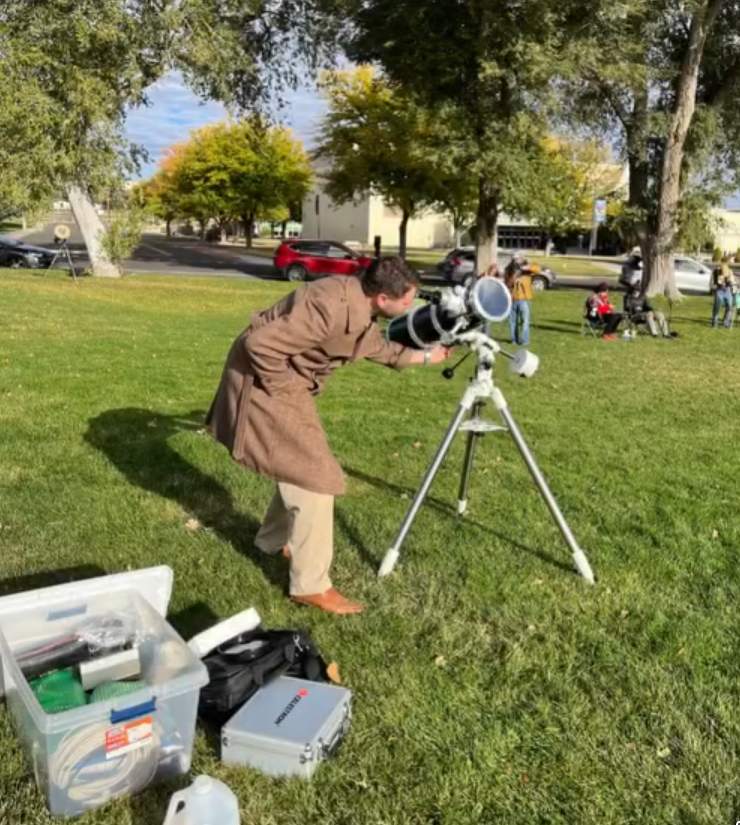
A mobile observatory carries the night sky to schools and public events across Northeastern Nevada. Telescopes are set out where neighbors, students, and families can look through them, from a school lawn to the eclipse gathering at Elko City Park. These evenings continue Dr. Thurston's public astronomy nights and are part of the laboratory's community involvement. The observatory goes to the people. Someone steps to an eyepiece and finds the moons of Jupiter, the mountains along the moon's edge, or the sun reduced to a careful, filtered disk. For many of them it is the first time the sky has been anything other than a backdrop. The look takes a minute. It can change how a person understands the size of the world they live in, and it can be the hour a student decides that science is a life they want.
These nights belong to the research program for the same reason the new materials and the new instruments do. A laboratory that hopes to change what the world can know has to share the habit of looking with patience and care, and public astronomy is that habit made visible. A student who stays after the crowd, asking how the mount is aligned or why one night is steadier than another, may be someone this program meets again. A town that gathers for an eclipse learns that demanding science is something their own laboratory will bring to the park and explain in plain language.
The same ambition runs through the whole program. New materials matter when they change what can be built. New instruments matter when they change what can be detected. Public nights matter when they change who feels that this work belongs to them. An evening at the eyepiece can start a vocation, give a teacher a lesson no slide can match, or send a family back outside on the next clear night. A student who stays late, a class that asks the observatory to return, a neighbor who brings a child to the next eclipse: each is a way research begun in this laboratory spreads. The sky is the most direct proof we have that careful looking can enlarge a life. Bring a class, a neighborhood, or a town event, and the observatory will bring the sky. Contact us to host a viewing.
From the Classroom to Practice
Ideas from the laboratory and the classroom become free tools for engineers, students, and the community. A method that once lived in a notebook or a private script can sit in a browser, ready for a designer sizing a channel, a student learning a mix, or a neighbor planning a system that has to work the first time. A good tool changes the work that gets done. It lets a careful method travel to a drawing board, a classroom, or a project site far from Elko, and it lets someone without a specialist at their shoulder still make a decision the laboratory would stand behind. These calculators are one way the research program leaves the building. They put disciplined engineering within reach, and they will grow as the program grows.
Free Helpful Design Calculators