
Frequently Asked Questions
We offer CRF trial batches and mix designs; cemented paste fill testing (including rheology, pump-line simulation, UCS, and triaxial); shotcrete, fibercrete, and ground support testing (including RDP and panel coring); aggregate, soil, and geotechnical testing; rock strength and stability testing, including point load, unconfined compression, and Brazilian tensile split; mine safety and MSHA-related support; custom protocols for non-standard materials; and data visualization, computational modeling, and quantitative risk analysis to turn test results into actionable decisions. See our services page for details.
We work closely with mine operators, engineers, and technical teams to design practical programs tailored to your project requirements, materials, and operating conditions. The goal is reliable data for evaluating material properties, performance, consistency, and quality—while supporting ongoing process control and optimization.
Round Determinate Panel testing follows ASTM C1550, Standard Test Method for Flexural Toughness of Fiber Reinforced Concrete (Using Centrally Loaded Round Panel). A round fiber-reinforced panel is supported on three pivots and loaded at the center. After the panel cracks, performance is reported as the energy absorbed up to a chosen central deflection.
ASTM C1550 notes that energy absorbed up to about 40 mm of central deflection is the range used when a lining may undergo large deformation, such as mine shotcrete. Energy to a smaller deflection, on the order of 5 mm, applies when cracks must stay tightly closed. Those results help compare fibercrete mixes and judge ground-support performance.
Thurston Laboratories performs RDP testing as part of our fibercrete and ground-support programs. See our services page.
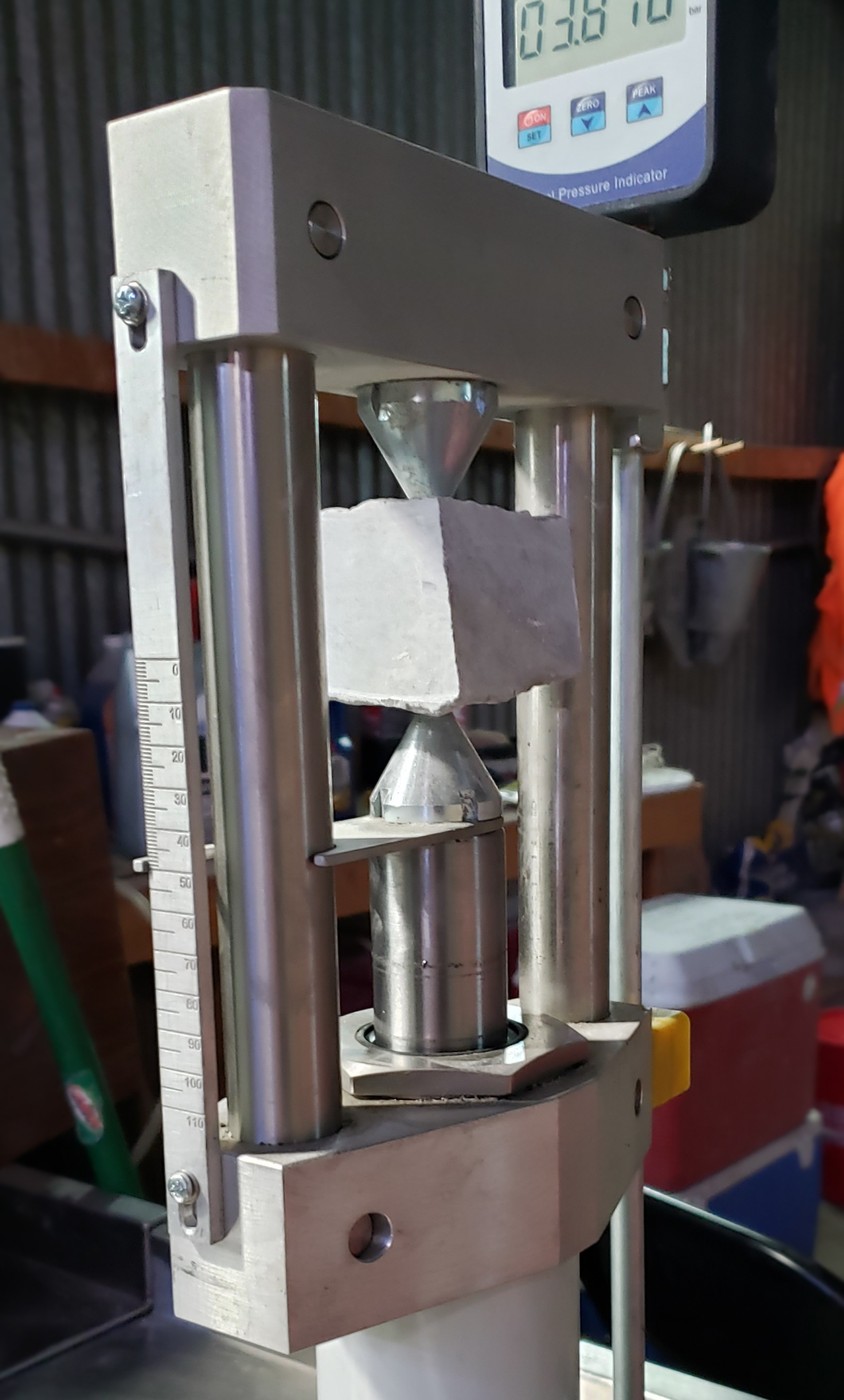
Point load testing follows ASTM D5731, Standard Test Method for Determination of the Point Load Strength Index of Rock and Application to Rock Strength Classifications. A rock specimen is compressed between conical platens until it splits. The failure load and the specimen size are used to calculate a point-load strength index. Results are commonly corrected to a 50 mm equivalent diameter and reported as Is(50).
The index is used to classify rock and to screen many samples, including irregular lumps. It is not a direct measurement of unconfined compressive strength. When the same rock is tested by both methods, a site-specific correlation to unconfined compressive strength can be developed. There is no single conversion factor that applies to every rock type.
Thurston Laboratories performs point load testing as part of our mining rock programs. See our services page.
Unconfined compressive strength (UCS) follows ASTM D7012, Standard Test Methods for Compressive Strength and Elastic Moduli of Intact Rock Core Specimens. A prepared intact core is loaded along its axis until it fails, and the result is the compressive strength of that rock.
Point load testing (ASTM D5731) is faster and needs less specimen preparation, but it reports an index rather than compressive strength. Use UCS when a design or stability evaluation needs the compressive strength of intact rock. Use point load when many specimens, or irregular pieces, must be characterized quickly.
Thurston Laboratories performs both tests as part of our mining rock programs. See our services page.
The Brazilian test follows ASTM D3967, Standard Test Method for Splitting Tensile Strength of Intact Rock Core Specimens. A disc, or a short length of core, is loaded across its diameter until it fails in tension along that diameter. The calculated result is an indirect tensile strength.
Intact rock is much weaker in tension than in compression. Tensile strength affects how rock fails around openings and along bedding, so the split test complements compressive-strength data when ground control is being evaluated.
Thurston Laboratories performs Brazilian tensile split testing as part of our mining rock programs. See our services page.
Contact our office to discuss your project, materials, and testing needs. We will help scope a program that fits your operations.
We accept cash, check, all major credit cards, Goldbacks, and Chamber Checks.
The Goldback is a voluntary currency containing real gold designed to facilitate easy exchange, even for small transactions. See the Goldback website for more information. We will offer a 5% discount on any amount paid in Goldbacks.